

WHAT DO WE DO NOW, BECOME NIGERIANS?
- OJUKWU BREAKS HIS SILENCE IN EXILE
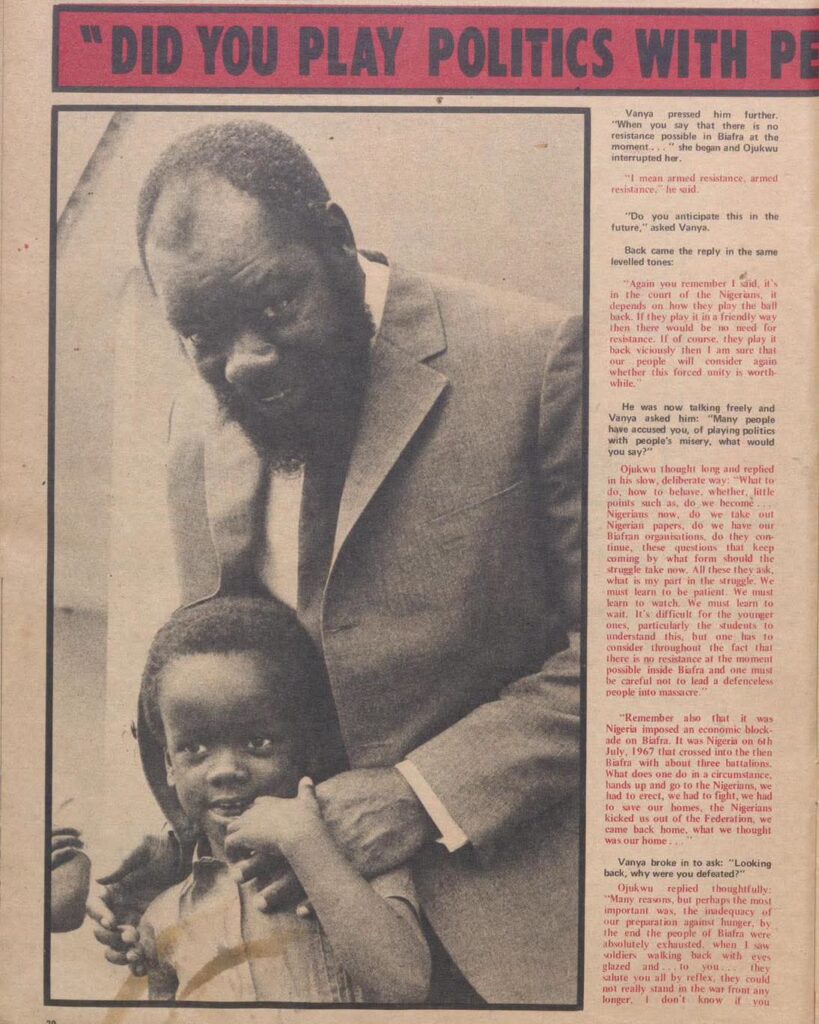
Come, let me take you back to 1970, just nine months after the Nigerian Civil War had ended.
Far away from Nigeria, in Yamoussoukro, Ivory Coast, Emeka Odumegwu Ojukwu was living in exile. For months, he had remained largely silent.
Then, according to this remarkable FLAMINGO magazine interview, he decided it was time to speak.
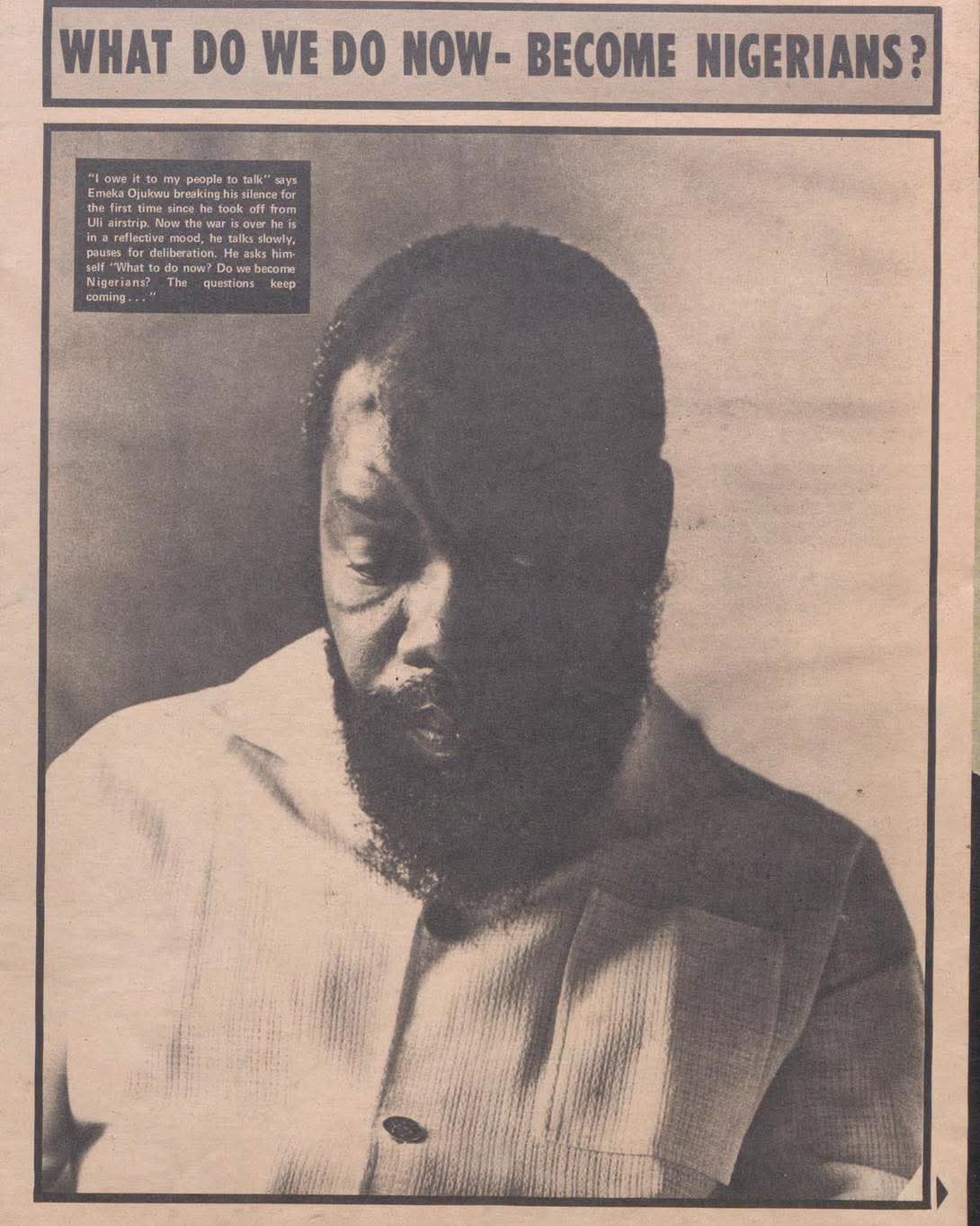
The headline on the page asks a question that captures the uncertainty of that moment: WHAT DO WE DO NOW, BECOME NIGERIANS?
The accompanying caption says: “I owe it to my people to talk.”
It describes Ojukwu as reflective, speaking slowly and pausing to consider his words.
The question he kept returning to was what came next now that the war was over.
What to do now? Do we become Nigerians?”
It is an extraordinary question to see in print because the man asking it had only months earlier been the leader of Biafra.
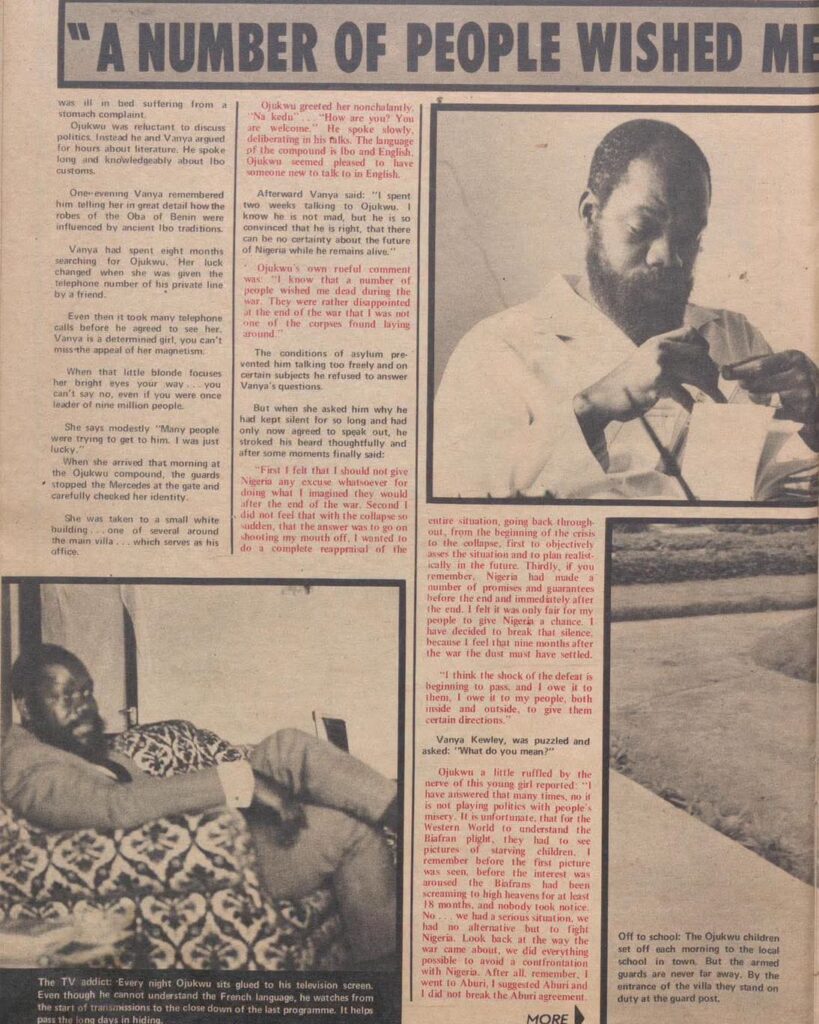
According to reporter Vanya Kewley, getting access to him had taken eight months.
When she finally reached the compound, guards stopped the Mercedes at the gate and checked her identity before taking her to a small white building that served as Ojukwu’s office.
When he saw her, he reportedly greeted her in Igbo: “Na kedu… How are you?
You are welcome.
Kewley wrote that Igbo and English were spoken around the compound and that Ojukwu appeared pleased to have someone new to talk to in English.
After spending two weeks speaking with him, she gave her own assessment of the man she had been interviewing.
She wrote that he was not mad, but was deeply convinced of his own position and remained uncertain about what Nigeria’s future would look like while he was alive.
Ojukwu himself also made a dark joke about the fact that he had survived the war.
He said he knew that some people had wished him dead during the conflict and joked that they had been disappointed when the war ended without him being among the bodies.
But the most revealing part of the interview was his explanation for remaining silent for nine months.
Ojukwu said that, initially, he did not want to give Nigeria any excuse for taking further action against him.
Secondly, he said he did not believe that immediately after such a sudden collapse he should continue speaking publicly.
He wanted time to reassess the entire situation.
Thirdly, he said Nigeria had made promises and guarantees before and immediately after the end of the war, and he felt his people should be given the opportunity to see whether those promises would be honoured.
By nine months after the war, he believed enough time had passed.
He therefore decided to break his silence because, in his words, he felt the dust had settled and the shock of defeat was beginning to pass.
He said he owed it to his people, both inside and outside Nigeria, to give them what he described as “certain directions.”
The interview then moved into the difficult question of how the war had begun.
Ojukwu rejected the suggestion that he was simply playing politics with the suffering of his people.
He spoke about the international images of starving Biafran children and argued that the world had ignored Biafran appeals before those images appeared.
He insisted that Biafra had tried to avoid confrontation and pointed again to the Aburi agreement, saying:
“I suggested Aburi and I did not break the Aburi agreement.”
That is Ojukwu giving his own account of the events that led to the Civil War.
It is important to remember that this was an interview with one of the principal actors in the conflict, so these statements represent his perspective and his interpretation of events, not an uncontested account of the war.
The photographs surrounding the interview also reveal the strange reality of his life in exile.
One caption describes him as a “TV addict,” watching television every night from the beginning of transmission until the final programme ended, even though he could not understand French.
Another photograph shows his children leaving for school in Yamoussoukro, with armed guards never far away.
Think about that contrast.
The former leader of Biafra, once at the centre of a devastating war, was now living behind security walls in a foreign country, watching French television, receiving letters, writing, thinking about the future and sending his children to a local school under guard.
Nine months had passed since the guns fell silent.
And now Ojukwu was speaking again.
Not from Enugu.
Not from Uli.
Not from the battlefield.
But from exile in Yamoussoukro.
“What do we do now, become Nigerians?”
More than half a century later, that question remains one of the most striking lines from this extraordinary interview.
Source: FLAMINGO Magazine, archival interview with Emeka Odumegwu Ojukwu, reported by Vanya Kewley; “As told to Gerry Malmed,” 1970/71.
Heart 2 Heart With Sammy
#Ojukwu #BiafraHistory #NigerianCivilWar #NigerianHistory #FlamingoMagazine #AfricanArchives #Heart2HeartWithSammy #newsnow.africa