

By Innocent Adulugba
The Federal Government has declared a zero-tolerance policy against truck congestion and environmental degradation around the Ibeju-Lekki corridor, reaffirming its dual commitment to operating safe seaports and maintaining a clean ecosystem.
The resolution was reached during a high-level stakeholders’ meeting at the Lekki Deep Seaport in Lagos, convened to address growing concerns over traffic gridlock and environmental sustainability in the rapidly expanding economic zone.
Speaking at the event, the Senior Special Assistant to the President on Transportation and Mobility, Prince Adetokunbo Ademola Ade-John, emphasized that the current administration views the efficient operation of the port as a national priority.
“President Bola Tinubu prides the Lekki Deep Seaport as a facility that must be run on best practices,” Ade-John stated. “Transportation is an enabler, and the seaports have created a transportation business hub with a flurry of ceaseless business and logistics systems that must continue running under watchful coordination.”
He stressed that all operational facets—including drayage, terminal access, gate systems, and the digital Truck Appointment System (TAS)—must be optimized to achieve peak efficiency.
The presidential aide also commended Alhaji Aliko Dangote, Chairman of the Dangote Group, for his partnership with the government in driving job creation and infrastructure development. Ade-John noted that the massive investments in the Dangote Refinery and Fertilizer Plant have transformed the Ibeju-Lekki corridor into a bustling business district, which has consequently triggered a massive influx of heavy-duty trucks.
To manage this traffic, Ade-John expressed confidence in the eCall-Up scheduling system to significantly reduce wait times and eliminate gridlock. He further charged security and regulatory agencies, including the Federal Road Safety Corps (FRSC), the Nigerian Navy, and the Nigeria Police Force, to enforce order and maximize turnaround times for port operations.
Corroborating the government’s stance, the Federal Controller of Works in Lagos State, Engineer Olufemi Dare, stressed the critical need for safety, regulatory compliance, and convenience for port operatives.
“A functioning trucking and drayage system around a seaport requires coordinated physical infrastructure, strict regulatory compliance, digital scheduling, and efficient yard operations to move cargo smoothly between ships and the inland network,” Dare explained.
He issued a stern warning to operators, announcing that both federal and state Ministries of Works are commencing strict enforcement along the corridor. “There will be zero tolerance for defaulting truckers and truck parks, and we urge the managers of the Call-Up system to up their ante for improved service delivery,” he added.
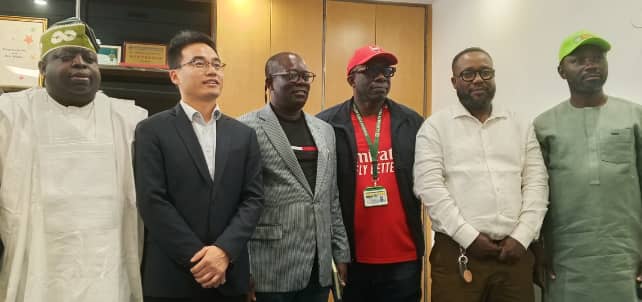
The meeting drew key stakeholders across the maritime and security sectors. Prince Ade-John was received by Mr. Wang Qiang, Chief Executive Officer of Lekki Port, alongside Nigerian Ports Authority (NPA) Port Manager, Mr. Emmanuel Anda, and other senior management staff. Top officials from the FRSC, the Nigeria Police Force, and the eCall-Up system management were also in attendance to solidify the new operational framework.