

From the pitch to policy: How Amanu Pinnick, other experts expose leadership weakness in Nigeria sports
…as experts discuss economic realities in the country.
By Chris Onuoha
Cowry Asset Management’s Quarterly Economic Discourse (QED) for the second quarter of 2026 kicked off on a positive note, bringing to the fore salient economic discussions that reflected today’s realities.
The hybrid event engaged financial experts and analysts, stakeholders, football administrators, policymakers and a discerning audience in a panel discussion that highlighted Nigeria’s major economic trajectory, shared insights on the country’s economic outlook and policy reforms, and examined the implications for businesses and investors.
It also underscored Cowry Asset Management’s commitment to fostering informed dialogue and thought leadership on issues shaping Nigeria’s economy.
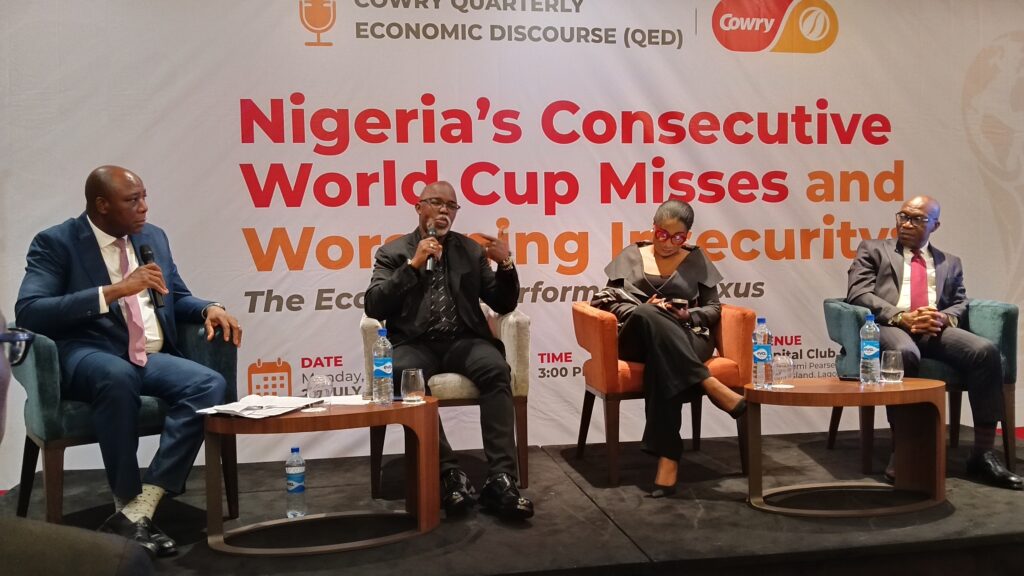
The interactive forum, themed “Nigeria’s Consecutive World Cup Misses and Worsening Insecurity: The Economic Performance Nexus”, featured as panelists former Nigeria Football Federation (NFF) President Amaju Melvin Pinnick, who shared insights on how eluding sports glory exposed administrative lapses and also affected the country’s economy.
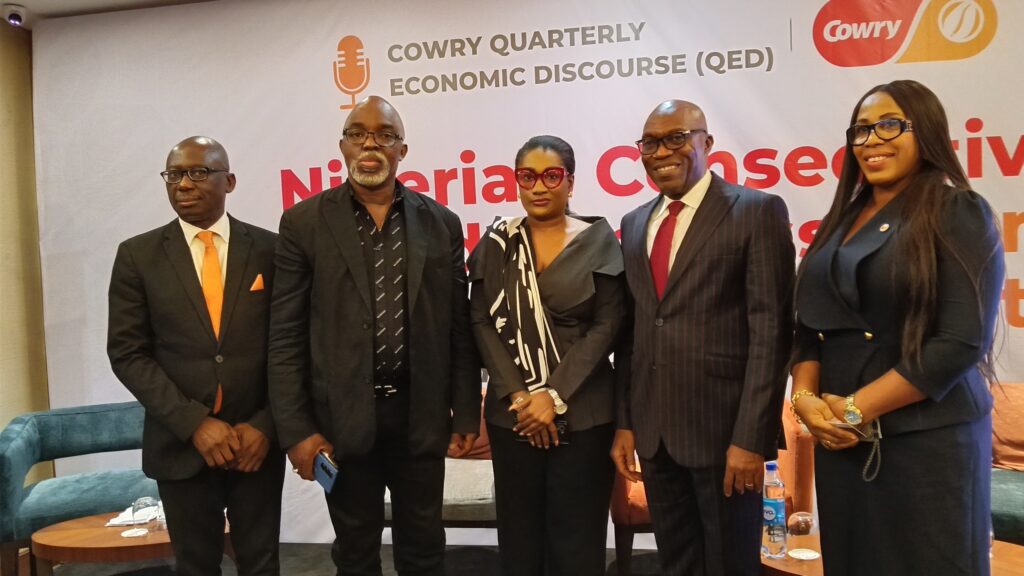
Others included Prof. Bongo Adi, a data analyst; Dr. Dakuku Peterside, a public affairs commentator and newspaper columnist; Ms. Chinwe Egwim, a financial expert and banker; and Mr. Johnson Chukwu, Group Managing Director of Cowry Asset Management. The programme was anchored by renowned broadcaster and financial analyst Boason Omofaye.
The panelists examined the relationship between national competitiveness, investment, governance and sustainable economic growth.
Amaju Pinnick reiterated his stance that football is a serious business that should not be left in the hands of maladministration.
“In Nigeria, football can be creative or entertaining or a fitness thing. It is a big business. In the UK, it is much more than what you can comprehend, where you have the head of the Football Association sit with the King of England and discuss critical issues on football, and if there is a problem, it will reflect on the economy,” Pinnick said.
Stressing his points from the book Politics Among Nations, he explained that Nigeria, as a country, has natural and human resources that have not been harnessed to full use, noting that the fundamental factor affecting their full usage is leadership failure.
Pinnick noted that football cannot be separated from the economy, saying: “Having interfaced globally, I believe that the country can favourably compete for greater glory in the sports sector, and we are getting there. But if you look at where we are in the country today, you will see that there is so much to be done.”
Pinnick maintained that the country, with its global ranking at 26 per cent, surpasses any other sector in Nigeria in the global index rankings. He also mentioned the remarkable medal table finish at the Glasgow sports, saying that if the country takes sports seriously, it should be the area of concentration to project Nigeria for responsible global reckoning.
He stressed the synergy between sports and administration, noting that football does not operate in isolation. “It operates in the polity. But the operators, administrators and staff are not projected and protected. My eight years in office as NFF President were marred with series of integrity checks and undue meddling from the graft agencies, EFCC and ICPC, not because we did anything wrong, but because people wanted a change of leadership for no cogent reasons.
“But the irony is that government at that point was too busy to know what was going on, until attention was eventually drawn. I was exonerated through an honest scrutiny by the Presidency, who was not aware of the gameplay,” he said.
He also explained how the NFF was able to navigate out of its challenges during his tenure through resolute and pragmatic approaches. These, according to him, endeared him to the Presidency, which gave a thumbs-up to his achievements towards 80 per cent self-sustenance by the football body.
“As of 2022, NFF didn’t have a sponsor after winning the Cup in 2013, and things were really bad before I contested the election. After I got the job, I engaged some consultancy firms to do a job for us. Within that period, we moved from zero per cent to 80 per cent self-funding, but unfortunately, I came under attack by some groups within the body for doing what was right to help NFF become self-sustaining,” he added.
He, however, underscored the major challenges as lack of structure and administrative lapses, using Morocco as a case study, under which their football body, in synergy with the government, has established a practicable framework for winning the World Cup in the near future.
“Running sports business is very simple. It is just about the political will to push things. We have talents in abundance. Lack of sports infrastructure and government not being intentional in providing protection for the administrators do not help matters. Sports promote tourism, and these are right indicators to positive economic growth.”
In the same vein, Prof. Bongo Adi, a Nigerian economist and data analyst, said Nigeria’s competitiveness continues to suffer because of inadequate infrastructure and insecurity. He also noted the high cost of doing business in Nigeria. Though the government charges only 10 per cent for tax, businesses continue to suffer losses due to non-state taxes, which do not even get to the government.
He stressed the need for improved infrastructure and policy consistency to support business growth and enhance national productivity.
Contributing to the discussion, Mr. Dakuku Peterside, a public policy expert, said Nigeria’s competitiveness depends largely on building strong institutions and implementing long-term development strategies.
According to him, the country’s challenges in football mirror broader governance issues. “Our failure in football is not a coincidence but a mirror of everything wrong at home. Football is a reflection of everything right and wrong with our nation. There are no long-term plans, no systems, no structures. But the resources are there.”
He maintained that Nigeria requires systems capable of outlasting individual administrations if it hopes to compete effectively on the global stage, and that sustainable progress can only be achieved through effective planning and institutional reforms.
He charged the Nigerian government to look into reforms that can benefit its citizens to become productive and create more economic opportunities by proper management of the sports sector, rather than worsen the economy by spending on elections.
Speaking on the country’s macroeconomic outlook, Ms. Chinwe Egwim, a Nigerian economist and banker, said Nigeria has witnessed relative exchange-rate stability in recent months and now ranks fourth globally in the stock market, although inflation remains a major concern. She observed that government policies should focus more on productive sectors capable of stimulating economic growth and creating employment.
According to her, sectors such as agriculture, agro-processing, manufacturing, transportation, the creative economy and real estate value chains possess enormous potential to transform the economy if given adequate attention.
Mr. Johnson Chukwu, Group Managing Director of Cowry Asset Management, in his welcoming keynote speech, highlighted the social effects of the failure to qualify for and participate in the 2026 World Cup tournament.
He noted that social life became boring after the tournament, indicating that beyond entertainment, football has a place in human social life and, by extension, a nation’s economy.
He stressed that sports should not merely be viewed as entertainment but as an important contributor to economic development through job creation, entrepreneurship and youth empowerment, also noting that discussions on competitiveness should go beyond sports and focus on the structures that drive national development.
Reflecting on the topic under discussion, Chukwu interrogated Nigeria’s preparedness in competitive edge despite huge human and natural resources. He lamented that the country is failing because youths are lacking in capacity upskilling at an early stage of their lives.
According to him, countries that attain sustainable development deliberately nurture their human capital from childhood, investing in education, skills acquisition and talent development long before the results become visible.
Chukwu observed that while the country has produced several talented footballers representing clubs and national teams internationally, the domestic system has failed to maximise those talents, which is revealed in missing the World Cup as a nation but having 16 of her players playing for nine other countries.
Chukwu identified insecurity as one of the greatest threats to Nigeria’s competitiveness. With the major crisis since 2019, insecurity has continued to expand from Boko Haram to banditry and terrorism, to Fulani herdsmen, pipeline vandalism and kidnapping for ransom.
He said the impact of insecurity on the economy has reduced investments in states affected by violent conflicts, while forcing many productive citizens to abandon their communities, weakening productivity, disrupting businesses and discouraging both local and foreign investors from committing resources to affected areas. Brain drain, as people in IDP camps are not useful to the economy, is another consequence.
On Nigeria’s competitiveness, Chukwu stated that with Nigeria’s population at over 240 million, with 42 per cent being youths, the impact of youthful creativity is not felt because their raw talent is undermanaged.
Chukwu, on the sideline of the event, explained reasons for organising the programme, noting that it is a desire to provoke national conversation on the ailing economy.
“The reason why we organise this particular session of the quarterly conversation is because Nigeria missing the World Cup is an indication of failure due to negligence in an area where the country has a comparative advantage.
“We may not be effective or efficient or competing in every field, but for the areas where we have comparative advantage, we should not ignore.
“For us at Cowry Asset Management, we deemed it necessary to bring this to the fore, that we, as a country, are failing where we are supposed to do best.
“Through the conversation, we have to identify some level of connectivity with the development of the country for economic retrogression, particularly related to household disposable income.
“We also realise that for those households that cannot afford the basic necessities of life, they could find it difficult spending resources grooming their children. And we are conscious of the fact that skills are developed at the best prime age of human life, which is age 25. That’s where you have the skills, all the education, the competencies and technical skills.
“These also lead us to the issue of insecurity, with lots of young people having no skills and becoming a challenge to the nation.
“For us, Cowry Asset Management, we want to instigate discussions and possibly proffer solutions to have Nigerians that will deal with issues in developing, encouraging and nurturing competence that would make us become not just in sports, but in economic issues, in technology, healthcare and in every aspect of human development. And that is what underpinned the decision to host the programme.”
Describing Cowry’s growing interest in projecting such a discourse, Chukwu said: “For us, we all have to contribute to the discourse of national issues, and if we should be the trigger point in such a robust discussion to challenge leadership at the private and public sector on the need for us, as a people, to focus on priority areas, we should be happy to be part of that.”
The key takeaway from the discourse points to a clear relationship between a nation’s failure to compete in areas where it has a comparative advantage and the failure of leadership in terms of nurturing those competences required to be a competitive society.